
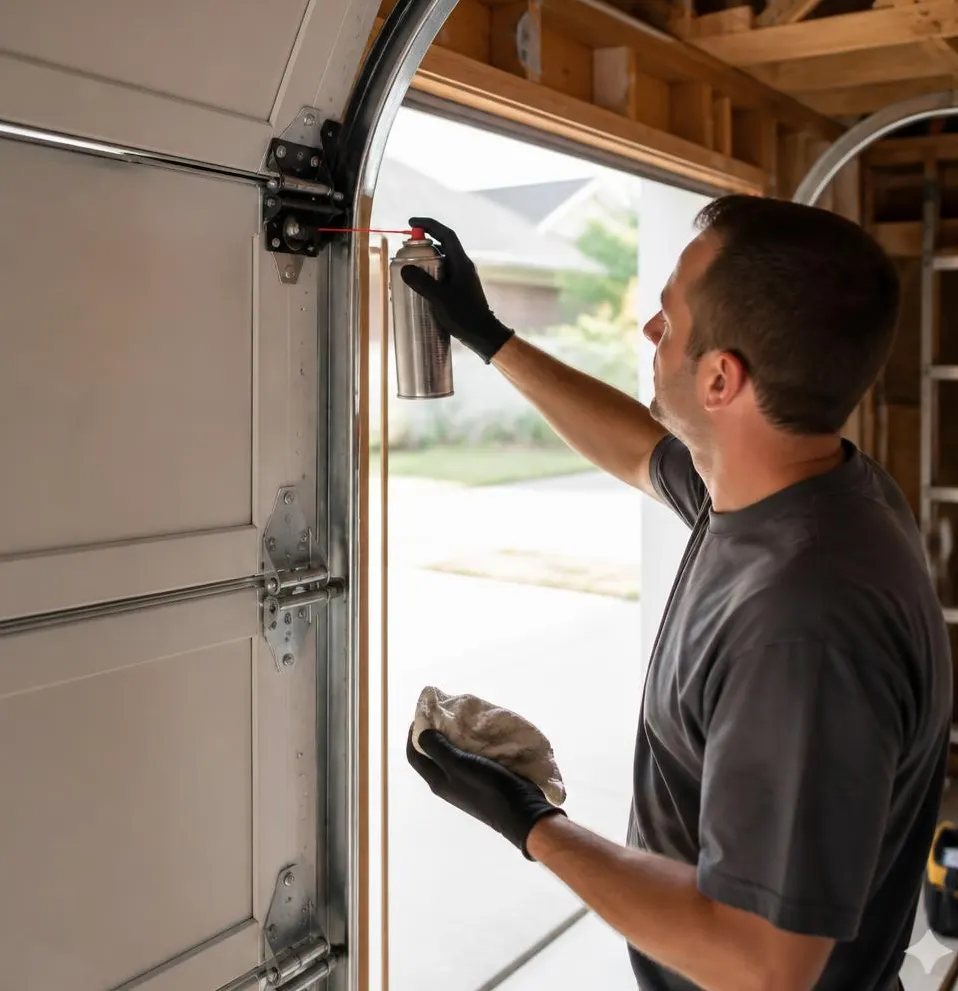
If your garage door starts down and then reverses back up, the photo-eye safety sensors near the bottom of the tracks are the culprit nine times out of ten — not a mechanical problem with the door itself.
The exceptions matter, though. If the door won't even attempt to close, that's usually a power, remote, or limit-setting issue rather than a sensor problem. If it reverses at the exact same spot on the track every time, that's a physical obstruction, not an electrical one. And if the door has felt heavy or slow for weeks before this started, a weakening spring or rusted cable is the more likely root cause, with the reversal just being the opener's safety system reacting to it.
Which Symptom Matches Yours
- Starts down, stops a few inches from the floor, goes back up — classic safety reversal, almost always sensor-related.
- Reverses at a random, different point each time — points to alignment or wiring, since a true obstruction would trip the door at the same spot.
- Reverses at the identical spot every single time — something physical is in the way, on the track, or in the door's path.
- Won't move at all when you press the button — different troubleshooting path entirely; see below.
- Opener light blinks a set number of times when you try to close it — many openers use blink codes to flag the exact fault; check the manual or the sticker on the motor unit before assuming the worst.
The Checklist a Technician Runs, In Order
1. Photo-eye safety sensors
These two small sensors sit a few inches off the ground on either side of the door, aimed at each other. If the beam between them is broken or blocked, the opener reverses the door rather than let it close on something. In this part of Florida, afternoon downpours and overnight humidity leave condensation and water spots on the lenses often enough to cause false reversals. Storage boxes, lawn equipment, or a bike leaned against the frame can also nudge a sensor out of alignment over time. The fix is simple: wipe both lenses clean, confirm the small indicator light on each sensor is solid (not blinking), and check that both units are level and pointed squarely at each other. If a housing is cracked or the wiring has corroded, the sensor gets replaced rather than realigned.
2. Something physically blocking the path
Before touching any settings, a tech walks the full travel path of the door — tracks, rollers, weatherstripping, and the floor line. Grit, sand, or swelling in a wood door jamb from ongoing moisture exposure can create just enough resistance to trip the force sensor. This check matters most when the reversal happens at the same spot every time.
3. Opener force and limit settings
Every opener has adjustable settings for how far the door travels and how much resistance it will push through before deciding something's wrong. These settings can drift, and they also need occasional retuning as a door's weight changes — a steel door that's picked up surface rust, or a wood door that's swollen slightly from humidity, won't travel exactly the way it did when the opener was first calibrated. Adjusting this means running the door through a few test cycles while fine-tuning the down-force and limit screws or digital settings, a process that takes patience more than tools.
4. Torsion springs under strain
If the door has felt heavy, closed slower than normal, or the opener motor has sounded like it's straining, the torsion spring above the door may be losing tension or rusting from repeated humidity exposure. A weakened spring means the opener is doing more lifting and lowering work than it's built for, which can trigger safety reversals as a side effect even though the sensors themselves are fine. This is not a DIY fix — torsion springs are under heavy tension and require the right bars and technique to adjust or replace safely.
5. Cables and rollers off track
Worn rollers or a cable that's frayed or slipped off its drum will throw the door slightly off-square as it travels, which can trip the force sensor even without a spring problem. A visual check along both sides of the door, looking for a roller that's not seated in the track or a cable with visible fraying, usually confirms this quickly.
6. Opener logic board or motor
Last on the list because it's the least common cause: a failing circuit board or worn motor gear can send bad signals that mimic a sensor fault. This gets ruled in only after everything above checks out clean.
When It Won't Close At All
This is a different branch of troubleshooting. Start with the basics — remote batteries, wall switch, and breaker — before assuming hardware failure. After that, check whether the sensor beam is broken constantly rather than intermittently, which some openers treat as a full stop rather than a reversal. A broken torsion spring will also often stop a door from closing altogether, since the opener's safety logic won't force a door down against that much resistance.
When to Call Lake Hamilton Overhead Door Co
If you've cleaned and realigned the sensors and the door still won't behave, or if you suspect a spring or cable issue, that's the point to call in a technician rather than keep adjusting settings. We handle Garage Door Spring Repair and Garage Door Cable & Roller Repair regularly across Lake Hamilton, Haines City, Dundee, and the surrounding Polk County area, and most of these calls get diagnosed and fixed in a single visit — including resetting force and limit settings so the problem doesn't come right back with the next humid afternoon.
If your garage door in Lake Hamilton, FL is reversing, stalling, or refusing to close, give us a call and we'll get it sorted the same way a technician would check it — in order, starting with the simplest fix first.