
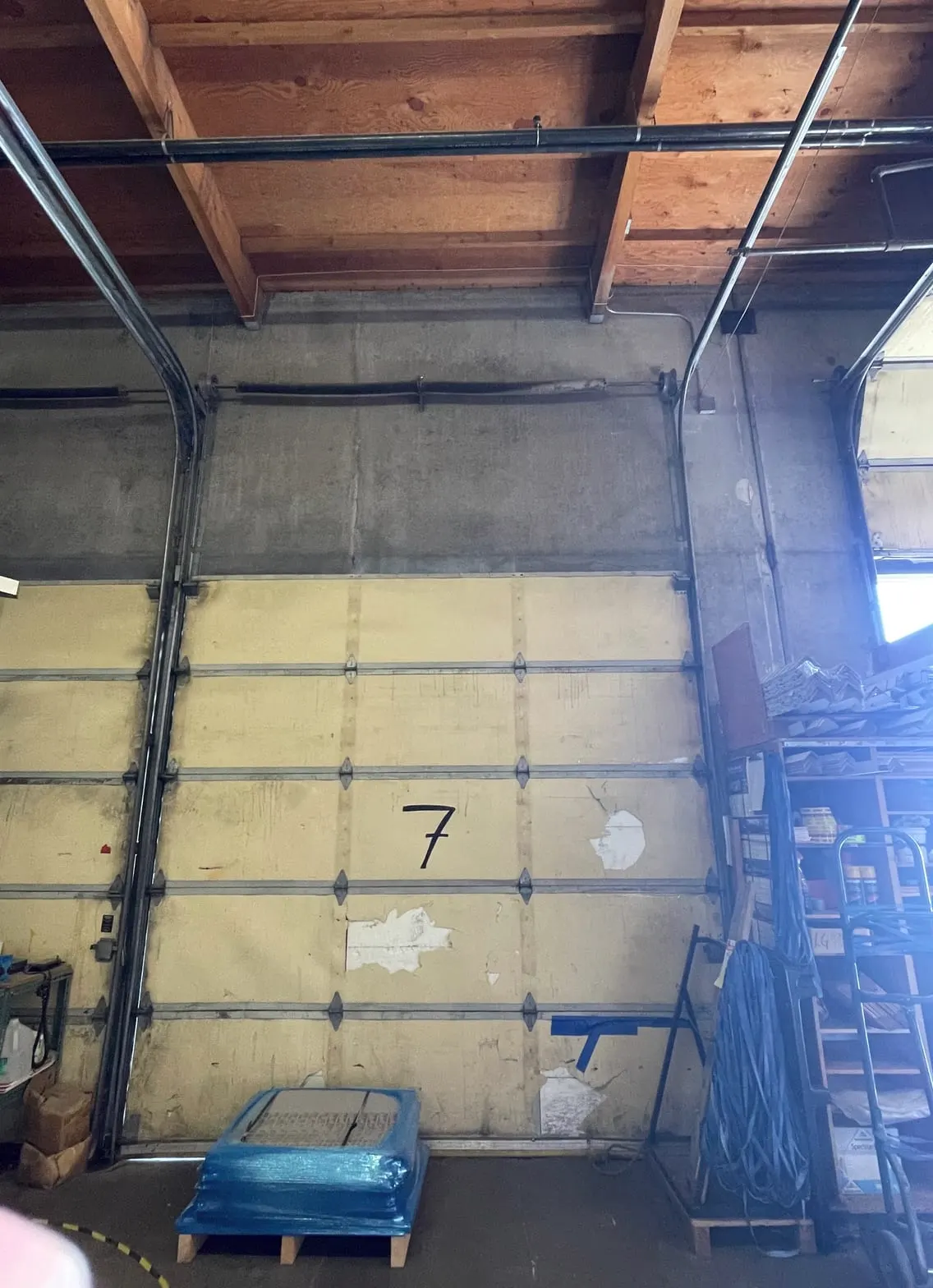
The One-Sentence Rule
If a door is wider than a single car and gets opened more than a handful of times a day, it's not a residential garage door anymore — it's a commercial door, and it needs to be treated differently, full stop.
The exceptions: a detached garage used as a small home workshop with light daily traffic is still residential-grade, even if it looks industrial. And a small retail storefront with one roll-up door that opens twice a day doesn't need the same bracing as a warehouse bay that sees a forklift every ten minutes. Size matters less than how hard the door works.
What Actually Makes Them Different
Cycle Count
A residential garage door is built to handle somewhere around 10,000–20,000 open-close cycles over its lifetime — a few times a day for years. A commercial bay door at a shop or distribution point can rack up that many cycles in a single year if it's opening dozens of times a shift. That's why commercial doors use heavier-gauge steel, reinforced hinges, and springs rated for high-cycle use. A residential spring bolted onto a commercial door will wear out fast and can fail dangerously under that kind of repetition.
Springs and Hardware
Commercial torsion springs are usually built in pairs or sets, sized for both the extra weight of a bigger door and the sheer number of cycles. Tracks, rollers, and struts are also heavier gauge, because a wider door flexes more and takes more abuse from daily traffic — including the occasional bump from a pallet jack or forklift that a residential door would never see.
Openers
Home garage doors typically run on a 1/2 to 3/4 HP chain or belt drive opener. Commercial doors often use jackshaft operators mounted beside the door, or larger horsepower trolley operators built for continuous commercial duty — because a residential-grade opener motor burns out fast trying to lift a heavier door dozens of times a day.
Why Florida Weather Changes the Math
Wind-load rules apply to both residential and commercial doors here, but a bigger door has more surface area, which means more wind load to resist during hurricane season. Warehouse and commercial bay doors need bracing and hardware engineered for that exposure, not a scaled-up version of a house door's bracing.
Humidity and heat matter too. Warehouses and shop buildings are often less climate-controlled than a house, so condensation inside the door track can be heavier, and hardware left exposed near a loading dock corrodes faster — especially with salt air drifting inland during storm season. Afternoon downpours are rough on any door left open for ventilation during loading, since rain gets into tracks and rollers and they start sticking or rusting before anyone notices.
Maintenance: Why Twice a Year Isn't Enough
A homeowner can usually get by with a seasonal tune-up. A commercial door working high cycles needs more frequent attention:
- Monthly to quarterly visual checks on rollers, track alignment, and photo-eye safety sensors — especially if forklifts or trucks operate near the door.
- Lubrication more often than a residential schedule, since high humidity dries out lubricant faster and high cycle counts wear it off faster too.
- Bottom seal inspection — commercial doors get struck and dragged more than house doors, so seals wear out faster and let in moisture and pests.
- Spring and cable inspection at shorter intervals, since a commercial spring under constant use shows wear well before it visibly fails.
Skipping this on a commercial door doesn't just mean a squeaky morning open — it means a stuck bay door during a delivery window, or a spring failure that takes a door (and whatever's under it) down hard.
When to Call Lake Hamilton Overhead Door Co
If you're running a shop, warehouse, or any building with a high-traffic overhead door, don't wait for it to fail mid-shift. We handle Garage Door Maintenance & Tune-Up on commercial-grade doors with the inspection schedule they actually need, and we do Garage Door Spring Repair with properly rated commercial springs — not a residential patch job that won't hold up to the cycle count. If the door's already sticking, dragging, or coming off track under daily use, we'll diagnose whether it's a hardware mismatch, a worn seal, or something more serious before it becomes a shutdown.
Give us a call if your business door in Lake Hamilton, FL — or anywhere from Haines City to Winter Haven — isn't keeping up with the job you're asking it to do. We'll get it running right and keep it that way.